
Q1 2026 Quarterly Update
◤ IN REVIEW: Q1 2026
The first quarter added another chapter to what has been a volatile few years for investors - this time with a direct military conflict between the U.S. and Iran reshaping the landscape. Markets already digesting sticky inflation and softening growth were forced to contend with a geopolitical shock that disrupted global energy flows, injected uncertainty into the economic outlook, and tested both portfolios and investor psychology.
While the war has dominated headlines, it is important not to lose sight of what was already in motion. The U.S. economy entered this crisis from a position of genuine strength - our "US Resilience" theme remains intact, if under more pressure than at any point in recent years. The interplay between that resilience and the new stresses imposed by the conflict will define the quarters ahead.
◤ ECONOMICS
Growth & Inflation
Prior to the conflict, economic data painted a picture of decelerating but still positive growth. Q4 2025 GDP came in at just 0.7% annualized - a significant step down from Q3's 4.4% - weighed by the October-November government shutdown, softer exports, and moderating consumer spending. Full-year 2025 GDP landed at 2.1%, down from 2.8% in 2024. Unemployment sat at 4.4% with wage growth moderating. On the inflation side, Core PCE remained stuck around 3.0% - the "last mile" of disinflation continues to prove elusive.
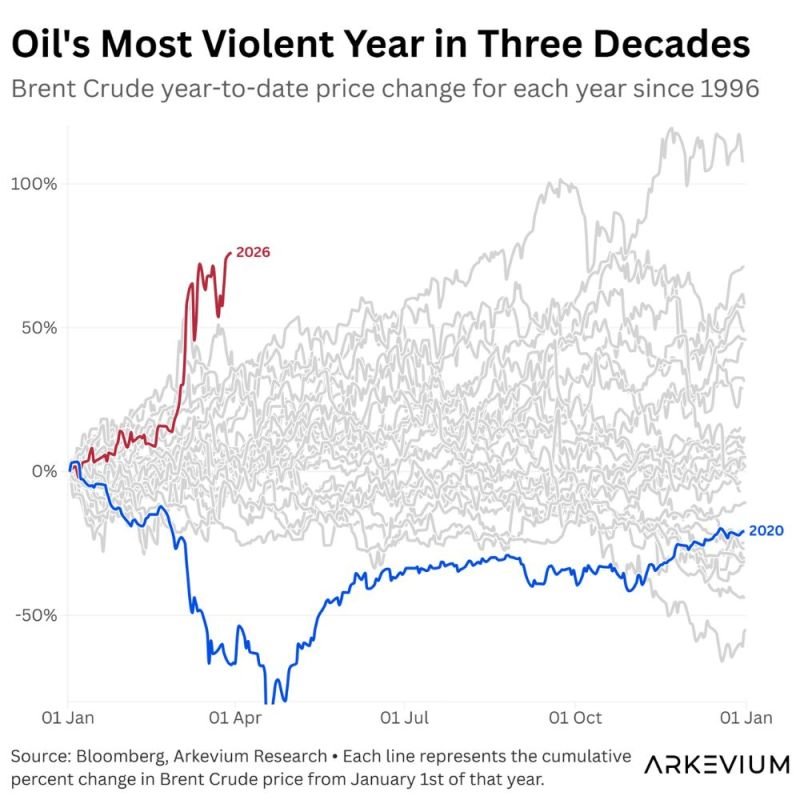
Then came the oil shock. Iran's closure of the Strait of Hormuz sent crude past $100 per barrel. The IEA has called this the worst energy disruption in history, with 7 to 10 million barrels per day lost. This isn't a traditional inflation shock. It's a consumer tax. At roughly $100 oil, the average household is absorbing close to a $2,000 annual hit. Unlike the post-COVID period, today's consumer is more constrained - higher energy costs are crowding out spending elsewhere. Higher energy costs show up in headline inflation, but the demand destruction they cause simultaneously puts downward pressure on core categories. If the Strait remains closed and costs stay elevated, second-round effects across supply chains could begin to embed more broadly.
That said, fiscal policy remains quietly stimulative, the AI investment cycle continues to accelerate, and a likely ramp in domestic energy production and defense spending provide meaningful offsets. Growth is likely to slow toward 2%, with an increasing chance of falling under, rather than contract outright.
Monetary Policy & Liquidity
The Fed held rates steady at 3.50-3.75% at both January and March meetings, projecting one cut for 2026. Powell called it "an energy shock of some size and duration" and noted the Fed would typically look through energy-driven inflation, but emphasized keeping longer-term expectations anchored.
The bigger story may be what's ahead. Nominee Kevin Warsh is expected to take over after Powell's term expires in May, and markets are looking through current hawkishness toward a more accommodative stance under new leadership. Globally, the picture is diverging - while most central banks eased in 2025, the oil shock has some now weighing hikes to stem imported inflation, adding complexity for global capital flows. The Fed has, of course, noted its tendency to look through “temporary” non-core shocks, but we certainly remember the "transitory" fiasco of covid-era inflation. There’s also the added complication of the actual end date of Powell’s term - for now, as long as the investigation into the Fed continues, Powell has insisted he won’t be leaving as Fed chair. It’s not clear if this is legally permissible; in any case, the investigation is only in preliminary stages.
The backdrop this creates is increasingly stagflationary - growth slowing while inflation stays sticky. That's the one economic regime where the Fed's dual mandate works against itself. Hiking deepens the slowdown. Cutting reignites inflation. The policy toolkit becomes constrained rather than effective. It's a key reason the Fed has been so cautious - and why the leadership transition matters as much as it does.
Financial Markets
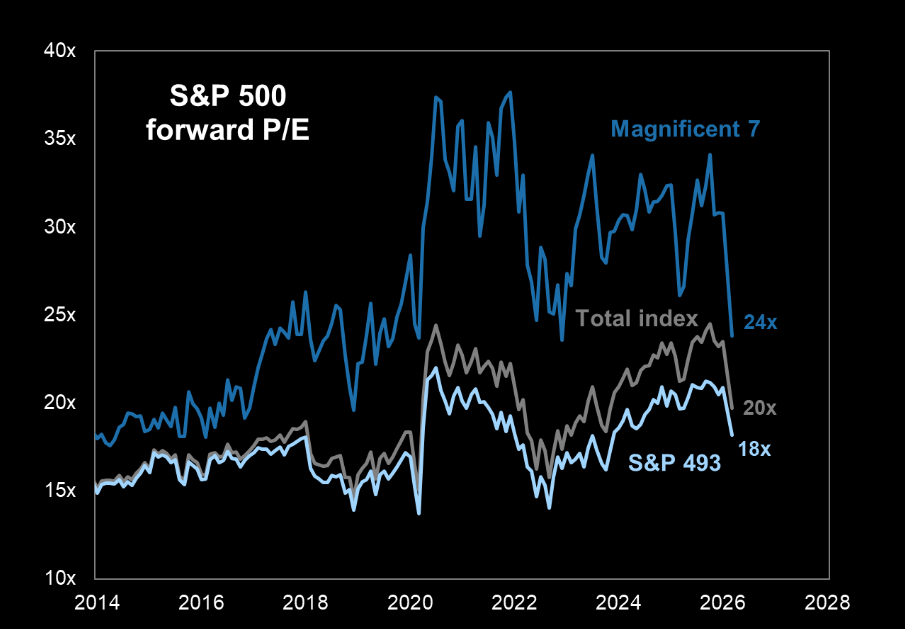
The S&P 500 fell approximately 4.6% in Q1, reflecting both pre-war valuation compression and post-February 28th risk repricing. The forward P/E fell from late-2025 highs of ~22x to approximately 19.8x - below its 5-year average for the first time in over two years. Leadership shifted meaningfully - energy, defense, and gold outperformed while technology faced renewed pressure after leading for three consecutive years. Mag 7 and technology multiples in general now are the cheapest they’ve been in many years.
◤ WHAT’S AHEAD
What is unfolding in the Middle East is not an isolated conflict centered on Iran. The larger issue is a broader struggle over global power, energy control, and the balance between the U.S. and China, with Russia aligned on the other side. Iran is better understood as a proxy battleground. The real strategic focus is control of global energy flows - particularly the Strait of Hormuz. That matters not just for oil prices, but for who secures access to energy, how pressure is applied to China, and what it means for the broader financial order. This appears to us more of a structural geopolitical shift, not a temporary headline event.
The drivers are bigger than any single data point - global conflict, competition for scarce commodities, persistent fiscal spending, and an increasingly fragmented global economy. The comparison to the 1970s is relevant, with one key difference: today's system is more leveraged, more financialized, and transmits pressures faster.
This is part of why markets have felt different recently. Rallies have been harder to sustain, leadership has narrowed, and volatility has persisted even in the absence of obvious economic deterioration. We don't think that changes overnight. Even if headlines improve, the underlying forces - geopolitical tension, fiscal expansion, inflation pressure - take longer to work through the system.
In this type of environment, we believe active positioning and selectivity matter more than they have in years. We continue to lean constructive, but more selective than at any point in the last two years.
Near - Medium Term (3-6 Months)
The next three to six months hinge on two variables: the trajectory of the conflict and the path of oil prices.
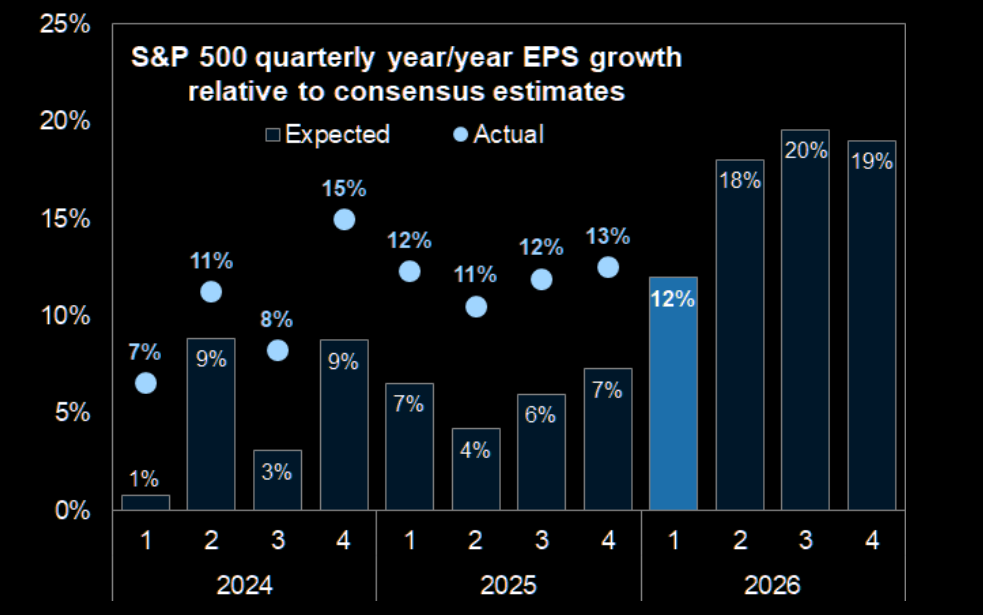
If the Strait reopens in the near term - through diplomacy, regime change, or multinational effort - oil retraces, consumer spending stabilizes, and equity markets likely stage a powerful relief rally. The underlying fundamentals - strong earnings (Q1 growth expected at 13.2%), resilient balance sheets, ongoing AI investment - would reassert themselves quickly. Markets have historically rewarded buying into geopolitical dislocations that resolve.
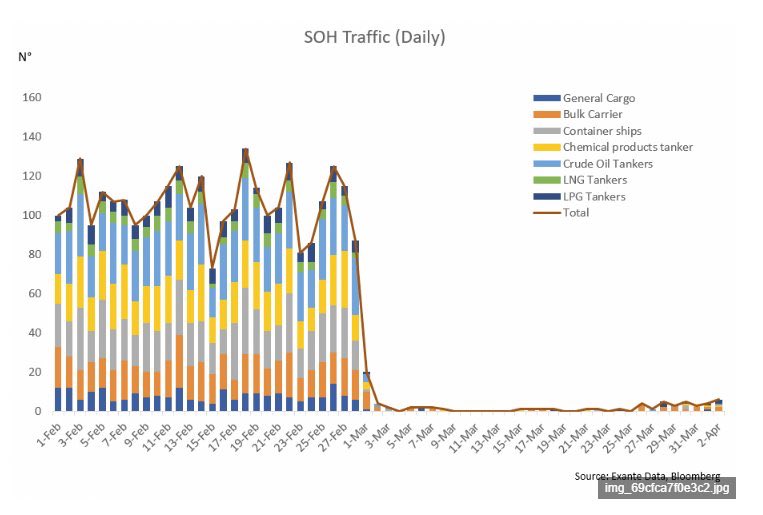
If the Strait remains closed beyond mid-April, the math gets considerably worse. Oil could push toward $150+, gasoline likely exceeds $5 per gallon, and recession risk rises materially.
Regardless of how the conflict resolves, the current setup - growth slowing while inflation stays sticky - creates elevated dispersion and volatility across asset classes. Our highest probability outcome for the near term is choppy, muted returns for both equities and bonds, with volatile but positive returns for gold and precious metals. Even a swift resolution does not undo the damage already done - disrupted supply chains, destroyed infrastructure, elevated insurance and shipping costs, and fractured energy relationships will linger well beyond any ceasefire. The pre-war status quo is not coming back. This is an environment that rewards selectivity and active positioning over passive exposure.
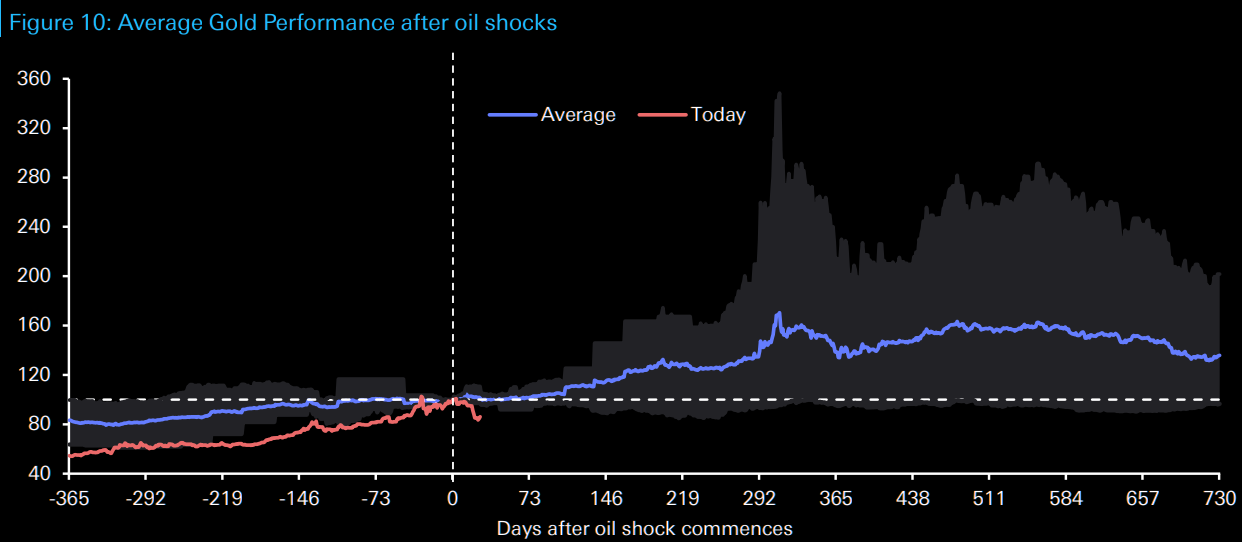
The active military component of this conflict can wind down quickly - Trump himself has suggested within weeks - but that alone won't clear the fog. As earnings season begins, we're cautious that some companies may use this moment to lower or withdraw forward guidance. And the Fed finds itself in an unenviable spot, with the transition to a new Chair later this year adding uncertainty - and potential opportunity, should Warsh adopt a more dovish posture.
Longer Term (6+ Months)
If the conflict winds down and oil normalizes, the second half looks meaningfully better: a likely more accommodative Fed Chair, ongoing fiscal stimulus, continued AI-driven productivity gains, and strong earnings (analysts project 17.4% full-year 2026 growth).
We're mindful that 2026 is a midterm year - historically the weakest in the presidential cycle, with larger-than-average drawdowns even when the broader trend is constructive. Additional volatility wouldn't surprise us.
More importantly, even if the conflict resolves, the structural forces don't disappear. Greater geopolitical competition, higher baseline commodity prices, persistent deficits, and a fragmented trading system - these are the conditions under which our Debasement theme becomes increasingly relevant. Assets that benefit - equities broadly, gold, and select alternatives - should continue to outperform over time.
We're also watching how rate expectations evolve from here. Markets have largely priced out further cuts - but if the oil shock drives enough demand destruction, cuts could get priced back in quickly. That shift would be a meaningful catalyst for both equities and bonds, particularly in rate-sensitive areas of the market.
◤ KEY LEVELS (AS OF APRIL 2026)
▸GDP Growth (2026 Est): 2.3%
▸Inflation (Y/Y PCE): 2.8%
▸Unemployment Rate: 4.3%
▸Fed Funds Tgt: 3.5 - 3.75%
▸10 Year Treas Yield: 4.3%
◤ REASONS TO BE BULLISH
Resolution Is Binary: If the Strait reopens, markets likely snap back quickly - positioning is already defensive and sidelined capital is substantial. Geopolitical dislocations that resolve have historically rewarded those who stayed invested.
Earnings Keep Delivering: Q1 growth expected at 13.2% - a potential sixth consecutive quarter of double-digit gains. Analyst revisions have been atypically positive, a rare and constructive signal.
Policy Tailwinds Are Building: A dovish new Fed Chair, fiscal stimulus from the Big Beautiful Bill, and above-average consumer tax refunds provide meaningful forward support for both growth and asset prices.
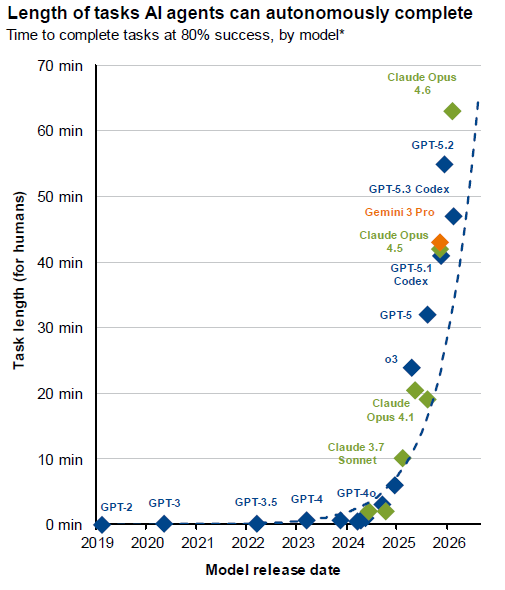
AI Adoption Is Still Early: 42% of large businesses deployed AI agents by Q3 2025, up from 12% a year earlier. Productivity gains are real and expanding - supporting margins and the broader growth picture. The human task length equivalent that AI agents are able to complete is growing at an exponential rate - this is complex, multi-step productivity from AI that should provide a healthy boost to efficiency and margins.
◤ REASONS TO BE BEARISH
The Clock Is Ticking on Hormuz: Every week the Strait stays closed, the supply math worsens. Oil at $150-$200 is plausible if disruptions persist - and fuel shortages would spread from Asia to Europe to the U.S., raising global recession risk significantly.
Stagflation Risk Is Rising: Growth is decelerating while inflation remains sticky and energy costs add further pressure. This is the one economic regime where the Fed's tools work against each other - cutting reignites inflation, hiking deepens the slowdown. Traditional portfolios tend to struggle in this environment, reinforcing the importance of alternatives, real assets, and pricing power.
The Consumer Is Exposed: Without post-COVID excess savings, the ~$2,000/household energy hit lands harder. Discretionary spending - the largest contributor to GDP - is increasingly at risk.
Escalation Is Not Priced In: The conflict has already spread beyond Iran into Gulf states and Lebanon. Further widening or a direct confrontation would represent a more severe shock than markets currently reflect.
◤ PORTFOLIO HIGHLIGHTS & CURRENT THEMES
Debasement & Real Assets: Gold (IAU) has been the standout performer, surging past $4,600 as investors flock to hard assets. Our gold exposure has been among the best risk-adjusted contributors across strategies this year. Bitcoin exposure (HODL, CDX) has faced more pressure as risk-off sentiment favored traditional safe havens, but we continue to hold as a longer-term expression of the Debasement theme.
Energy & Defense: ExxonMobil (XOM) and Chevron (CVX) have outperformed as the conflict spotlights domestic energy's critical importance. Defense exposure through ITA, along with XLI, HON, and CAT, has contributed positively as defense spending accelerates globally.
AI & Technology: Our largest thematic exposure remains the AI buildout. NVDA, MSFT, GOOGL, and AAPL have held up relatively well, reflecting conviction in the durability of the AI cycle. QQQ provides broad exposure across strategies. CRWD, PLTR, ANET, VRT, and VST round out our infrastructure and end-use case positions. While tech has underperformed energy and defense this quarter, AI adoption remains early-innings and the secular story is compelling.
Quality & Consumer Resilience: JPM, V, WMT, and COST reflect our emphasis on quality balance sheets and pricing power. BRK.B, UNH, and PG in Enhanced Growth add further defensive quality. LLY remains our highest-conviction healthcare name, with the metabolic disease innovation cycle providing a powerful secular tailwind.
Alternatives: BUCK, CTA, and QMNNX in Enhanced Growth, and the larger BUCK and CDX positions in Enhanced Income, have provided stabilizing, uncorrelated returns during elevated volatility - exemplifying our focus on absolute-return strategies. Our most aggressive portfolios have added alternatives stacked on traditional market exposure for added return diversity.
◤ CLOSING THOUGHTS
We won't sugarcoat it - this is a challenging backdrop. But perspective matters. The U.S. economy entered this crisis from strength. Earnings remain robust. AI investment continues. Fiscal policy provides a backstop.
The broader forces at play - geopolitical competition, fiscal expansion, and the Debasement dynamic - are not going away. This is the type of environment where active management matters most, which is exactly how we approach managing your wealth.
This content, which contains security-related opinions and/or information, is provided for informational purposes only and should not be relied upon in any manner as professional advice, or an endorsement of any practices, products or services. There can be no guarantees or assurances that the views expressed here will be applicable for any particular facts or circumstances, and should not be relied upon in any manner. You should consult your own advisers as to legal, business, tax, and other related matters concerning any investment. References to any securities or digital assets, or performance data, are for illustrative purposes only and do not constitute an investment recommendation or offer to provide investment advisory services. Charts and graphs provided within are for informational purposes solely and should not be relied upon when making any investment decision. Past performance is not indicative of future results. The content speaks only as of the date indicated. Any projections, estimates, forecasts, targets, prospects, and/or opinions expressed in these materials are subject to change without notice and may differ or be contrary to opinions expressed by others. Investments in securities involve the risk of loss. Clients of DePaolo & May Strategic Wealth may hold positions in the securities discussed in this content. Please see disclosures here.
Strategize With Us
Ready to achieve your financial goals?
Or fill out the form and we'll reach out within 24 hours.