
What the Iran Conflict Means for Your Portfolio
 (2).png)
The U.S. and Israel's expanding military campaign against Iran is the kind of geopolitical shock that understandably makes investors nervous. Strikes are hitting targets across multiple countries in the Middle East, the situation is evolving daily, and headlines are moving markets in real time.
Here's how we're thinking about it:
The Geopolitics Behind the Strikes
President Trump had been signaling an attack on Iran for weeks through a military buildup in the region and repeated public warnings to Iranian leadership. The stated objective has escalated from curbing Iran's nuclear ambitions (already significantly degraded after strikes on nuclear facilities last June) to outright regime change.
Trump has indicated the campaign could last several weeks and involve thousands of targets. But regime change is an extraordinarily difficult goal under any circumstances, and the political headwinds are significant. The President did not explicitly seek Congressional approval before launching the operation. Perhaps most critically, many of the voters who put him in office did so partly because he promised to keep America out of foreign wars. With U.S. military casualties already reported and more expected, there's a real tension between the scope of the mission and domestic political reality.
Our read: absent ground troops - which seem very unlikely given the political environment - the U.S. will need to rely on internal Iranian opposition to finish the job. That creates a strong incentive to wrap this up quickly, particularly with midterm elections approaching this fall.
It's Not Just About Nukes - It's About Oil
While the nuclear threat is the official justification, there's a broader strategic play at work. A more U.S.-friendly government in Tehran would give Washington substantially greater influence over global oil supply. Combined with the recent operation to seize control of Venezuelan oil assets, this would put the U.S. in a stronger negotiating position with China ahead of trade talks with President Xi, and help keep energy prices in check for American consumers. Note that China has historically sourced roughly 18% of its oil supply via Venezuela and Iran, although this number is likely even higher as oil supplies from these locations are often re-routed through non-sanctioned sources.
For our clients, this is worth watching closely. Energy prices ripple through everything - consumer spending, corporate margins, inflation expectations, and Fed policy. The strategic logic here could ultimately be disinflationary if it succeeds, but the transition period carries real uncertainty.
What Markets Are Telling Us
The initial reaction has been textbook geopolitical shock: volatile equity prices, rising oil and gold, and bond yields whipsawing. But the extreme moves have been short-lived so far, for a few reasons.
First, this wasn't a total surprise - markets had time to partially price in the risk. Second, investors have been conditioned over the past decade-plus to buy geopolitical dips, since these events rarely produce lasting earnings damage. Third, there's a scenario where this actually results in lower oil prices long-term if the U.S. gains more influence over Middle Eastern production, adding to its already dominant North American output and new Venezuelan supply.
That said, we see some important nuances that distinguish this from a typical geopolitical flare-up.
Oil prices may not fully retrace. About 20% of global supply flows through the Strait of Hormuz. While Iran's navy has been hit hard, it remains enough of a threat that tanker traffic could be disrupted. Both sides have so far avoided targeting energy infrastructure, which reduces the tail risk of a massive price spike - but short-term supply disruptions are still on the table.
Bond yields are starting to reflect higher inflation expectations. After an initial flight-to-safety rally, yields have reversed higher as the market prices in elevated energy costs. For our income-oriented portfolios, this is a dynamic we're monitoring carefully.
The "buy the dip" playbook may not work as cleanly this time. This isn't a single-day event. A multi-week campaign with uncertain outcomes for Iranian leadership means the overhang could persist, and there's a plausible path where higher energy prices and reduced consumer activity start to weigh on earnings estimates. This isn't necessarily the outcome, however, and there are reasons to remain optimistic - including more control long-term over the price of oil.
How We're Positioned
We are not making dramatic changes based on this event alone. Our investment philosophy has always been to build tactical portfolios that can navigate similar uncertainty. Geopolitical events are inherently unpredictable in their timing, duration, and resolution - and the historical track record of selling into them is poor.
Market Performance Around Geopolitical Events
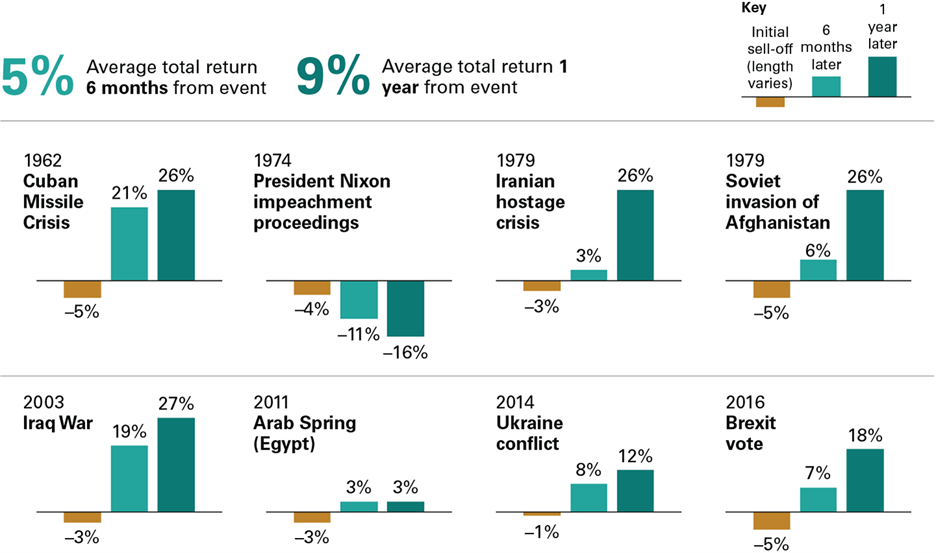
That said, we are paying close attention to several factors: the duration and scope of the campaign, any disruption to energy supply chains, the second-order effects on inflation and consumer spending, and how this interacts with other sources of market uncertainty that were already in play before the first strike - including questions around AI valuations and private credit exposure.
For clients in our growth-oriented strategies, we continue to favor diversification across sectors and geographies. For those in income-focused allocations, we're watching the bond market's inflation repricing closely and maintaining flexibility in duration positioning.
The Bottom Line
We don't expect a major stock market correction from this event as a base case. But we also don't think this is as simple as another "buy the dip" moment. The combination of an active military campaign, elevated energy prices, and pre-existing market concerns makes continued volatility the most likely near-term outcome. However, given the turbulence under the hood in markets prior to this - particularly the AI/tech space - we think valuations and the full-year outlook provide a constructive setup as we work through this conflict.
If you have questions about how this affects your specific situation, reach out to us directly. That's what we're here for.
This content, which contains security-related opinions and/or information, is provided for informational purposes only and should not be relied upon in any manner as professional advice, or an endorsement of any practices, products or services. There can be no guarantees or assurances that the views expressed here will be applicable for any particular facts or circumstances, and should not be relied upon in any manner. You should consult your own advisers as to legal, business, tax, and other related matters concerning any investment. References to any securities or digital assets, or performance data, are for illustrative purposes only and do not constitute an investment recommendation or offer to provide investment advisory services. Charts and graphs provided within are for informational purposes solely and should not be relied upon when making any investment decision. Past performance is not indicative of future results. The content speaks only as of the date indicated. Any projections, estimates, forecasts, targets, prospects, and/or opinions expressed in these materials are subject to change without notice and may differ or be contrary to opinions expressed by others. Investments in securities involve the risk of loss. Clients of DePaolo & May Strategic Wealth may hold positions in the securities discussed in this content. Please see disclosures here.
Strategize With Us
Ready to achieve your financial goals?
Or fill out the form and we'll reach out within 24 hours.