
Year End Review & 2026 Outlook
◤ IN REVIEW: EXITING 2025
The defining theme of 2025 was US Resilience. While policy headlines were noisy, the practical reality for markets was supportive: the Federal Reserve restarted an easing cycle, ended balance-sheet runoff, and began Treasury purchases designed to keep reserves ample. The Fed both raised projections for growth in 2026 and lowered inflation projections. As financial conditions loosened, equities also saw strong earnings, with 2025 full-year earnings expected to finalize around 12% growth.
In that context, U.S. equities finished 2025 near all-time highs, with the S&P 500 up roughly 18% on the year. Assets continued to benefit from our long-standing Debasement theme. By year-end, markets had digested four major forces:
▸Policy Volatility – Trade policy, fiscal negotiations, tariff threats, and mounting political friction drove periodic spikes in volatility.
▸A Jobless Recovery Dynamic – GDP growth persisted even as employment slowed, keeping aggregate wage pressures contained, thanks in part to productivity boosts from AI.
▸Liquidity vs. Valuation Tension – Expanding liquidity supported risk assets, while elevated starting valuations capped near-term upside, particularly toward year-end in hot tech segments.
▸Narrow Leadership – Market gains remained concentrated in AI-related megacaps for much of the year. However, this broadened out into more real-economy sectors by year-end as GDP prints were stronger than expected.
◤ THE MACRO BACKDROP ENTERING 2026
Growth
Our base case remains grounded in US Resilience, but with stronger near-term momentum than typical later-cycle playbooks would suggest. Incoming data exiting 2025 was notably firm - real GDP grew at a 4.3% annualized rate in Q3 2025, and the Fed’s GDPNow estimate for Q4 2025 is currently reading 5.4% annualized.
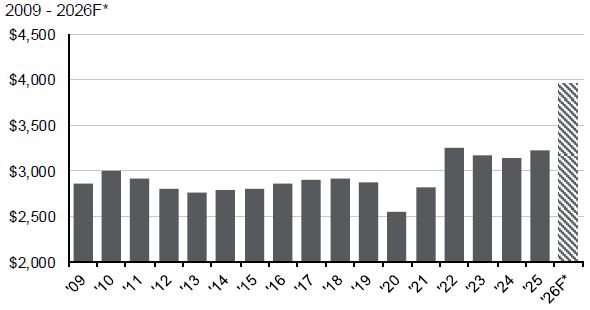
The key point: 2025 likely ends with stronger “carryover” into 2026 than consensus assumes. Combined with tailwinds from Fed easing, a measurable productivity impulse tied to AI/automation, and a more deregulatory policy mix, we believe the baseline for 2026 growth should be relatively strong. The potential for cash-flow support from sizable tax refunds further bolsters this view, with roughly 25% larger refunds expected for consumers on average versus the preceding 4 years.
Average Income Tax Refund by Filing Year
Source: JPMorgan
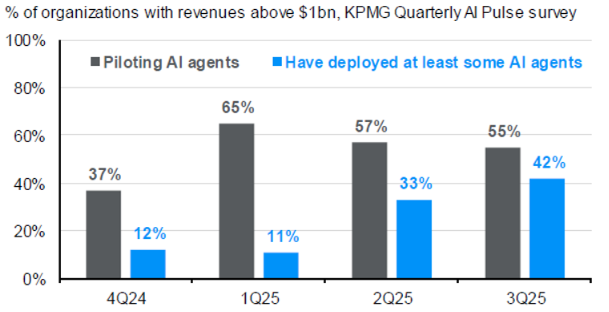
On the AI front, business surveys throughout 2025 reflect significantly increased AI use during the year. By Q3 of 2025, 42% of $1B+ businesses had deployed at least some AI agents, versus just 12% at the end of 2024. Across all business sizes, 17% reported use of AI by the end of 2025, up nearly 70% from early 2025 surveys. Despite this rapid growth, the overall usage remains relatively nascent across all businesses, with robust growth expected to continue. Small businesses in particular have a significant amount of AI-use upside relative to their larger peers.
AI Use by Large Businesses
Source: JPMorgan, KPMG
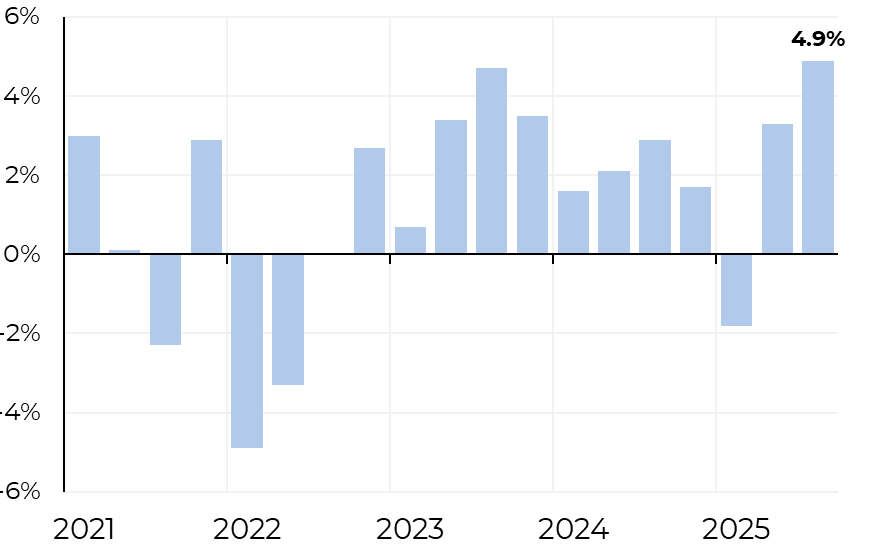
Strong productivity gains as a result of current and projected AI use should provide significant support for growth and earnings going forward. This is already starting to show up in big quarter-over-quarter productivity growth numbers in late 2025.
Productivity Growth (Q/Q Annualized)
Source: Steve Rattner, Trading Economics
Inflation
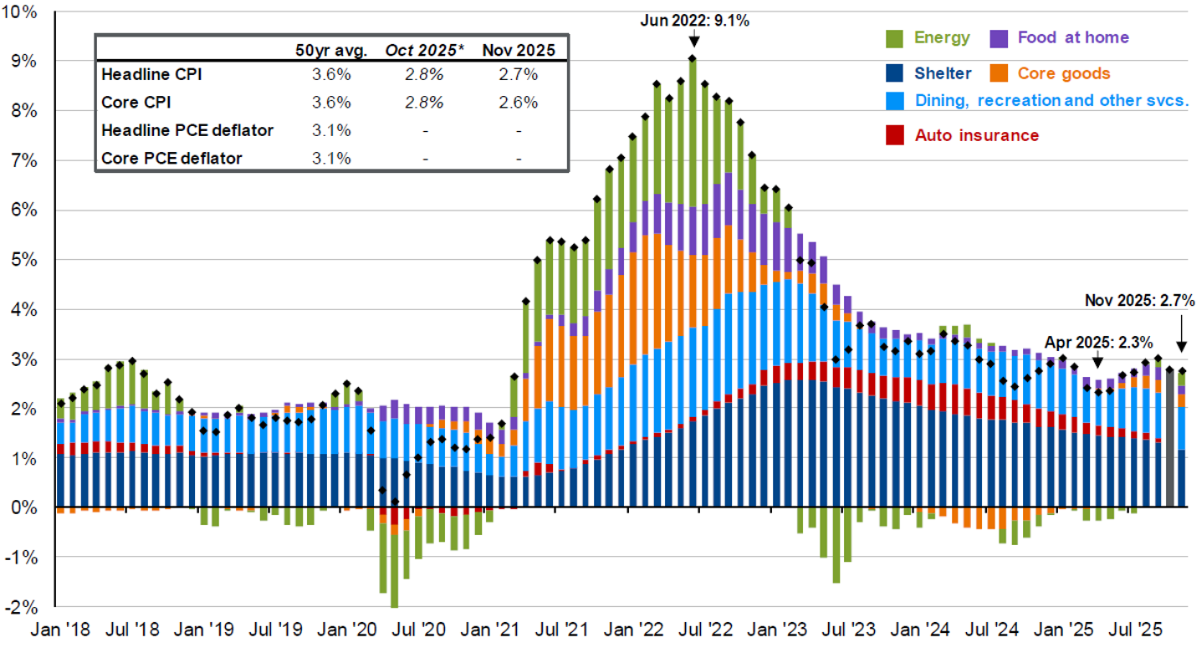
Inflation remains one of the market’s primary constraints. While headline inflation has cooled materially from its peak, the final mile toward the Fed’s 2% target remains uneven. Services inflation has been sticky, but leading indicators suggest continued disinflation through 2026 as shelter costs roll over, labor market tightness eases further, and productivity offsets wage pressure.
Inflation (Core PCE) and its Component Parts
Source: Goldman Sachs
Monetary Policy & Liquidity
2026 represents a policy regime transition year. With a dovish new Federal Reserve Chair expected and employment continuing to cool, the path of least resistance is toward lower policy rates. We expect markets to be highly attuned to more clarity over interest rate policy, the new Fed chair, and Fed liquidity management.
◤ WHAT’S AHEAD
Near - Medium Term (3-6 Months)
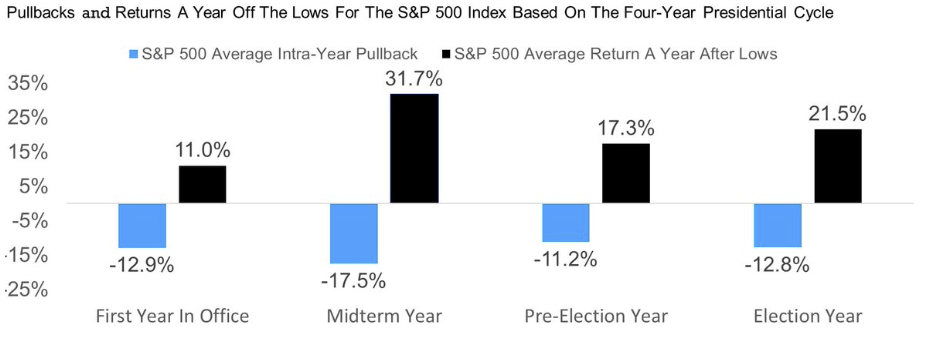
Strong S&P earnings, robust GDP momentum, and increasing clarity around continued Fed cuts (and the incoming Fed Chair) should provide a solid backbone for markets as we enter 2026. That said, investors should be prepared for heightened volatility early in the year. Historically, midterm years experience larger-than-average intra-year pullbacks, even when the broader trend remains constructive. We expect any such drawdown to occur in the first half of the year—most likely toward the middle to latter part of Q1— as positioning, seasonality, and policy uncertainty intersect. Importantly, this type of volatility has been a feature, not a failure, of midterm years, and should be viewed as a normal part of the market cycle rather than a signal of deteriorating fundamentals.
Midterm Years See Increased Market Volatility/Drawdowns
Source: Carson Investment Research
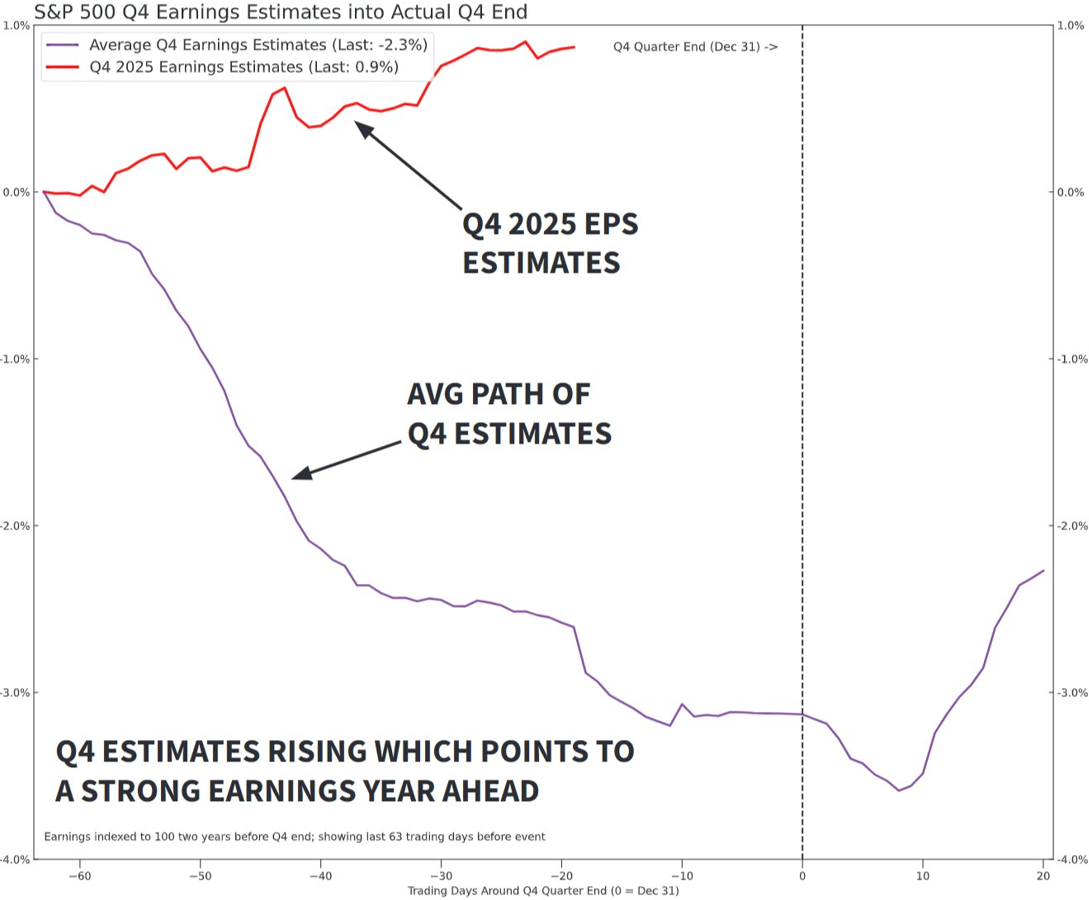
As we head into earnings season, estimates remain notably strong. S&P earnings expectations are typically revised modestly lower through Q4 into year-end; however, Q4 2025 saw earnings estimates revised nearly 1% higher through the quarter, an atypical and positive setup. Looking ahead, S&P earnings are expected to grow approximately 8% in 2026, still above long-term averages and consistent with our view that earnings durability—not macro stress—will be the primary driver for equities this year.
S&P 500 Earnings Estimates For Q4 2025 (vs all historical Q4s)
Source: 3Fourteen Research
Longer Term (6+ Months)
Looking further into 2026 and beyond, the backdrop appears constructive, with growth increasingly supported by policy, productivity, and private-sector investment rather than cyclical stimulus alone. As inflation continues to moderate and the Federal Reserve maintains an easing bias, financial conditions should remain supportive even if rate cuts proceed gradually.
Importantly, Washington policy becomes a more direct growth variable in this phase of the cycle. A combination of deregulation, a lighter-touch enforcement posture, and an increased focus on domestic investment and competitiveness has the potential to extend the expansion rather than shorten it. While fiscal deficits remain elevated, reinforcing our Debasement framework, the composition of policy increasingly shifts toward supporting capital formation, productivity, and corporate profitability.
At the same time, productivity gains driven by AI, automation, and infrastructure investment allow growth to run firmer than historical late-cycle norms without necessarily reigniting inflation. This dynamic supports a continuation of the current Jobless Recovery framework, where output and earnings remain resilient even as labor market growth cools.
As this backdrop evolves, the key transition we are monitoring is the market’s shift from pricing continued policy easing to recognizing that the rate-cutting cycle is approaching its end. That inflection matters because it can change how markets behave even if growth remains intact. As the focus shifts from “more cuts ahead” to “the cutting cycle is ending,” longer-term interest rates can move higher and valuations can become more sensitive to changes in earnings and inflation expectations. If that transition unfolds, we would expect to become more selective and incrementally more defensive, emphasizing durable earnings, pricing power, and inflation-aware exposures rather than relying on falling rates to support asset prices.
From an asset-allocation perspective, this regime reinforces a broader structural shift, from bonds as the primary diversifier to alternatives as the next generation of portfolio ballast. As investors reassess the reliability of sovereign debt as a diversifier, we expect a gradual but persistent reallocation toward commodities, precious metals, managed futures, and other less equity-correlated strategies, a structural, not tactical, shift with meaningful implications for portfolio construction.
From a market perspective, this environment continues to favor broader leadership. As policy and productivity tailwinds work through the economy, capital should increasingly rotate toward industrials, cyclicals, and under-owned sectors tied to real economic activity, while returns become more differentiated across companies and industries.
Taken together, the longer-term outlook suggests a cycle that is extended rather than exhausted, with Washington policy acting as a stabilizer for growth, even as deficits, debt, and currency considerations remain important longer-term risks to monitor.
◤ KEY LEVELS (AS OF JANUARY 2026)
▸GDP Growth (2025): 3.2%
▸Inflation (Y/Y PCE): 2.7%
▸Unemployment Rate: 4.4%
▸Fed Funds Tgt: 3.5 - 3.75%
▸10 Year Treas Yield: 4.2%
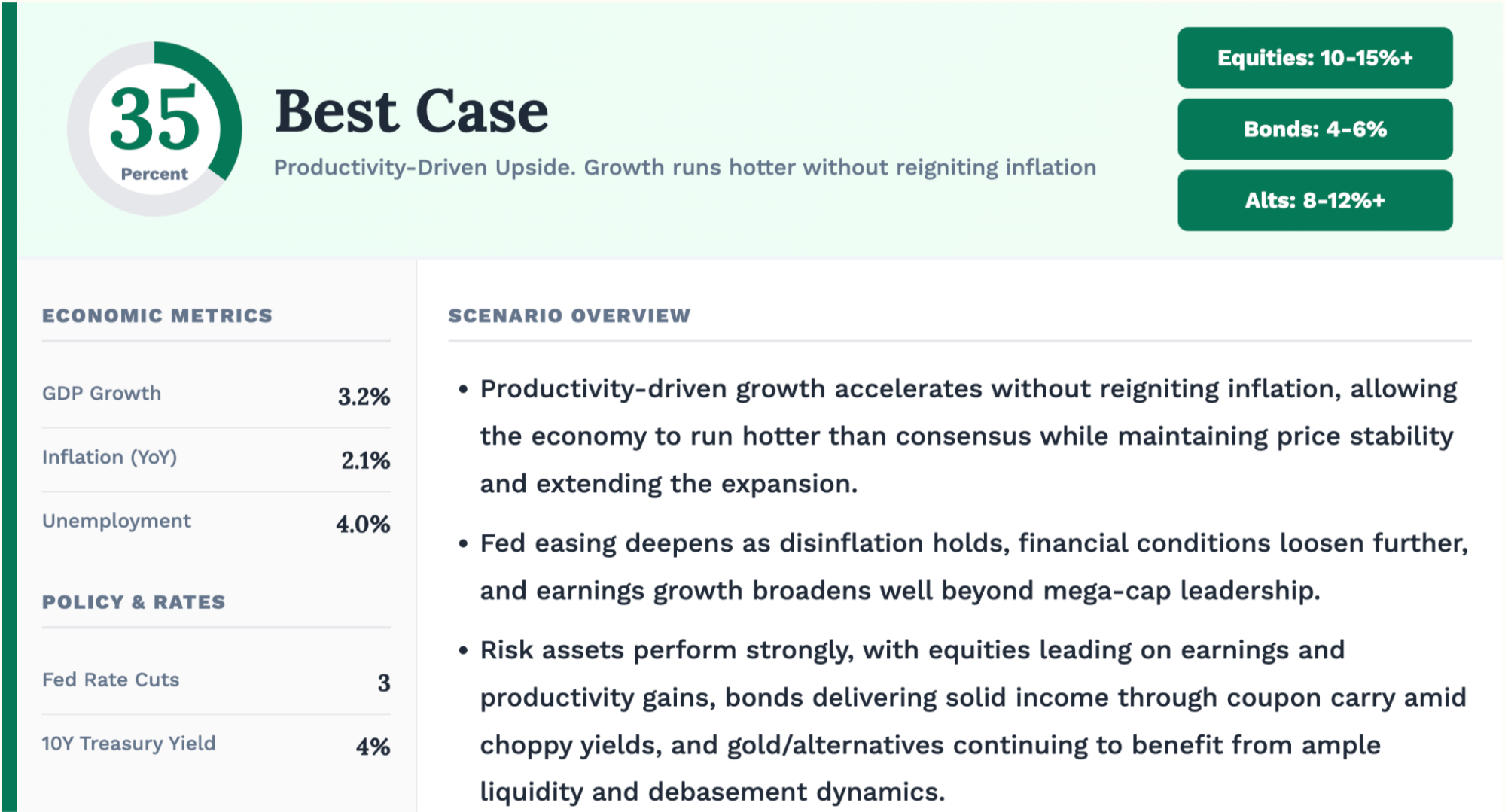
◤ 2026 SCENARIOS
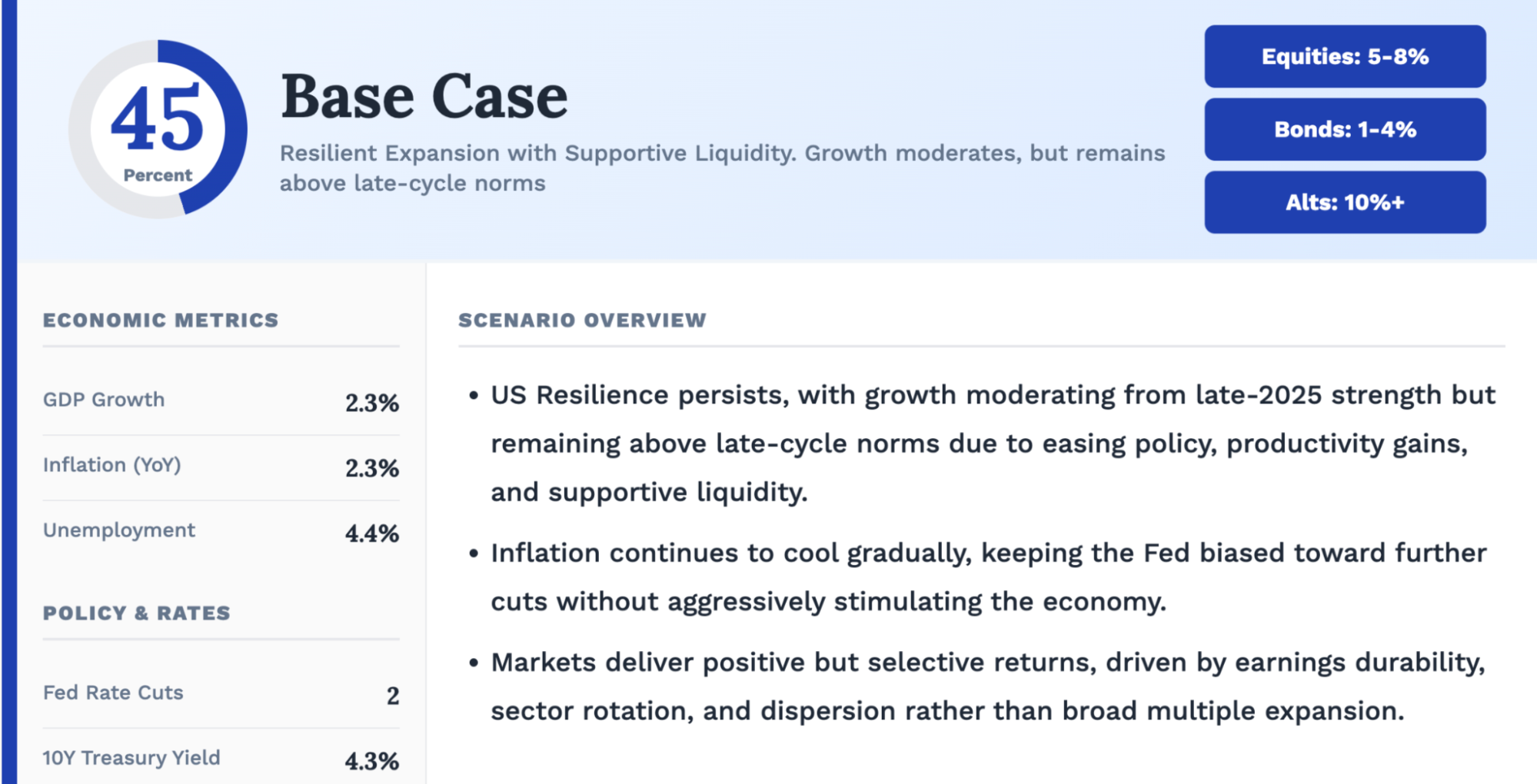
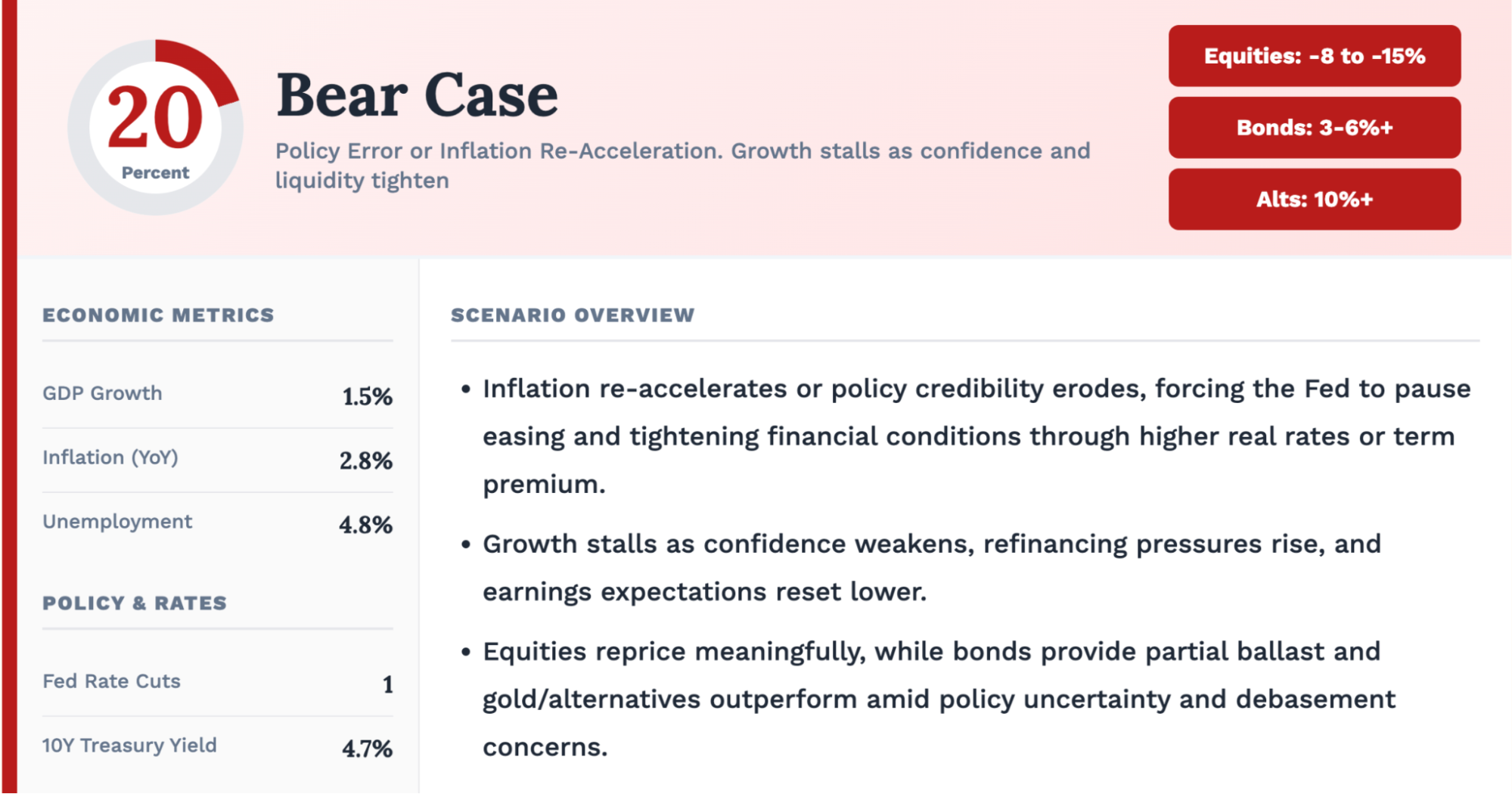
◤ 2026 THEMES IN FOCUS






◤ CLOSING THOUGHTS
As we move into 2026, the investment landscape continues to be defined less by cyclical fragility and more by structural change. Our U.S. Resilience theme remains, supported by easing monetary policy, improving productivity, and a policy backdrop that increasingly favors domestic investment and capital formation. At the same time, inflation progress remains uneven, and markets remain highly sensitive to shifts in policy.
We expect this to be a year characterized by broader leadership across assets, sectors, and strategies, with selective outperformance driven by earnings durability, pricing power, and exposure to long-term secular themes. Traditional portfolio frameworks continue to evolve, with alternatives, real assets, and inflation-aware strategies playing an important role alongside equities in-line with our Debasement theme.
While near-term market pullbacks are possible - particularly as policy transitions unfold - we view these periods as part of a normal and healthy market process rather than a signal of deteriorating fundamentals. Our focus remains on managing risk through cycles while staying positioned for the opportunities created by structural forces such as AI-driven productivity, domestic manufacturing investment, defense and energy security, and ongoing Debasement dynamics.
Through all market conditions, our commitment remains unchanged: to protect capital, remain disciplined, and allocate opportunistically where we see the most attractive risk-adjusted returns. We appreciate the trust you place in us and look forward to navigating the evolving market environment together. As always, please don’t hesitate to reach out with any questions or thoughts.
Sincerely,
Kyle & Dane
This content, which contains security-related opinions and/or information, is provided for informational purposes only and should not be relied upon in any manner as professional advice, or an endorsement of any practices, products or services. There can be no guarantees or assurances that the views expressed here will be applicable for any particular facts or circumstances, and should not be relied upon in any manner. You should consult your own advisers as to legal, business, tax, and other related matters concerning any investment. References to any securities or digital assets, or performance data, are for illustrative purposes only and do not constitute an investment recommendation or offer to provide investment advisory services. Charts and graphs provided within are for informational purposes solely and should not be relied upon when making any investment decision. Past performance is not indicative of future results. The content speaks only as of the date indicated. Any projections, estimates, forecasts, targets, prospects, and/or opinions expressed in these materials are subject to change without notice and may differ or be contrary to opinions expressed by others. Investments in securities involve the risk of loss. Clients of DePaolo & May Strategic Wealth may hold positions in the securities discussed in this content. Please see disclosures here.
Strategize With Us
Ready to achieve your financial goals?
Or fill out the form and we'll reach out within 24 hours.